
Sussex County Probate Records
Sussex County probate court records are held by the Circuit Court Clerk in the town of Sussex. If you need to find a will, locate an estate file, or look up a guardianship order, the clerk's office is the right place to start. You can search records in person, by mail, or by phone. The court keeps will books and fiduciary files that go back to the early days of the county. Use these probate records to track estate settlements, find heirs, and confirm property transfers in Sussex County.
Sussex County Overview
Sussex Circuit Court Clerk
The Clerk of the Circuit Court in Sussex County keeps all probate court records for the county. The office handles the proving of wills, the qualification of executors and administrators, and the appointment of guardians. You can stop in to view files, send a request by mail, or call the clerk for help. If you plan to file for probate, set up a time with the staff first so they can pull what you need.
| Office | Sussex County Circuit Court Clerk |
|---|---|
| Address | P.O. Box 1337, Sussex, VA 23884 |
| Phone | (434) 246-5511 |
| Hours | Monday through Friday, 9:00 AM to 5:00 PM |
| Website | Sussex County Circuit Court Clerk |
The clerk is a constitutional officer who serves an eight-year term. Under Virginia Code Title 64.2, the clerk has the power to admit wills, qualify personal representatives, and appoint guardians. This same rule applies in every Virginia circuit court. The Sussex County clerk also keeps deeds, marriage licenses, and civil case files. But for estate matters, the probate desk is the place to ask for help.
Note: Call the clerk at (434) 246-5511 before you visit to set up a probate meeting and confirm hours.
Searching Sussex Probate Records
There are a few ways to find probate court records in Sussex County. The simplest is to go to the clerk's office and ask to see will books or fiduciary records. Staff can help you locate files if you know the name of the person whose estate is on file. You can also send a written request by mail with the full name and the date of death. Phone calls work for short questions but not for long searches.
For older Sussex County records, the Library of Virginia holds microfilm copies of will books and estate papers from the 1700s and 1800s. Some files have been scanned and added to FamilySearch, where you can view them for free. The Virginia probate forms portal has the forms you need to file new probate cases or request copies of old ones.
Virginia Code Section 64.2-446 says any person with a real interest in a will can ask to view it once it has been admitted to probate. Certified copies cost a small fee per page plus a certification charge. These copies serve as legal proof of estate filings for banks, title firms, and tax offices.
Filing Probate in Sussex County
When you go to the Sussex County Circuit Court to start probate, bring all the documents you need. The clerk cannot move forward if key items are missing. Plan to set aside an hour or more for the first meeting. Here is what to have ready:
- A certified copy of the death certificate
- The original will, not a copy
- A list of heirs with names, addresses, and how each one is related to the deceased
- A list of all real estate the person owned in Virginia, with values
- An estimate of the value of personal property
- Payment for fees and the state probate tax
If the will is self-proving with a notarized affidavit, the witnesses do not need to come to court. If it is not self-proving, the witnesses must give sworn statements. Virginia Code Section 64.2-452 says a will must be proved by two competent witnesses before the clerk can admit it. Non-Virginia residents who serve as executor must name a Virginia resident agent to accept service of process.
Sussex Probate Fees and Taxes
Probate in Sussex County involves more than one fee. The state charges a probate tax of 10 cents per $100 of estate value. Local tax may also apply. These are paid at the time of qualification with the clerk. The clerk can tell you the exact total when you file.
Recording fees depend on how long the document is. A short will of ten pages or less costs less than a long one. Qualification fees vary based on the size of the estate. Small estates under $5,000 may pay no fee. Larger estates pay more. You can find the current fee chart on the Virginia courts fiduciary forms page.
After qualification, the executor must file an inventory with the Commissioner of Accounts within four months. Virginia Code Section 64.2-1300 sets out the rules for these filings. The Commissioner reviews each inventory and all later accountings. The fees for this review are based on the size of the estate. For tax questions, see the Virginia Department of Taxation site.
Types of Sussex Probate Records
The Sussex County Circuit Court keeps a wide range of probate court records. These files show how estates were settled over the years. The main types are wills, estate inventories, executor bonds, fiduciary accounts, and guardianship orders. Each tells part of the story of how a person's property moved to heirs after death.
Will books in Sussex County hold the last wishes of past residents. They list heirs, real estate, and personal items. Estate inventories list every asset a person owned at death, from land to farm tools to household goods. Fiduciary accounts show how the executor handled the estate's money. Bond records prove the personal representative posted the required security with the clerk.
Guardianship and conservatorship records are also part of the probate court files. When a child inherits or an adult cannot manage their own affairs, the court names someone to act for them. These files are open to anyone with a real interest. The Virginia Bar Association estate guide has more on each record type.
Legal Help for Sussex Estate Cases
Probate law can be hard to follow on your own. The clerk's staff can answer basic questions about forms and steps, but they cannot give legal advice. If you need help with your role as executor or want to know your rights as an heir, talk to a lawyer. The Virginia State Bar offers a referral service that can put you in touch with a probate attorney.
For lower-cost help, Virginia Legal Aid may be able to assist if you meet the income rules. The Virginia Bar Association also puts out a free guide to estate work that walks you through each step. For federal estate tax info, see the IRS estate tax page.
The Virginia Judicial System portal has an overview of how probate works across the state. Use it to learn about deadlines, forms, and the duties of personal representatives in Sussex County.
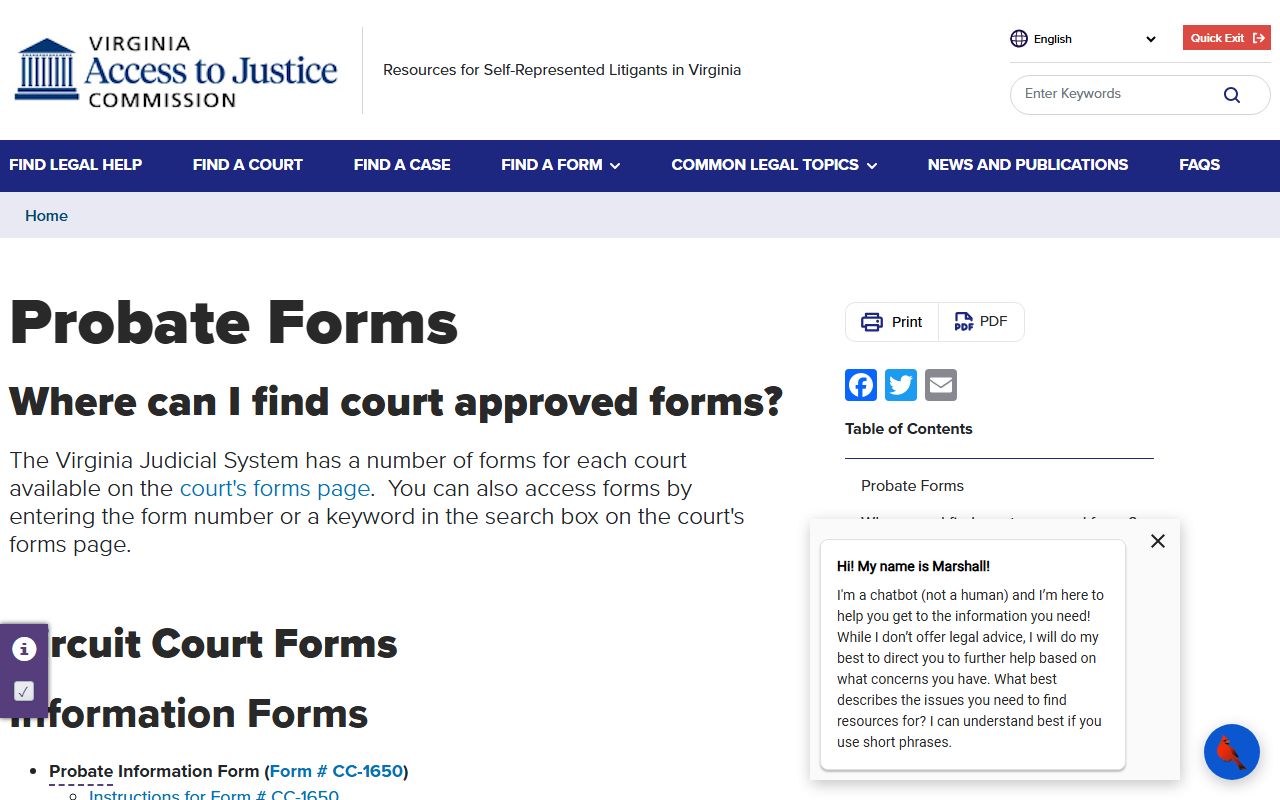
The portal lists all the forms used in Virginia probate cases, including those filed in Sussex County Circuit Court.
Sussex Historical Probate Records
Sussex County was formed in 1754 from part of Surry County. Probate records from the late 1700s still exist in the county will books. These files are key for genealogists and local historians. Early wills sometimes use old spelling and may name property by farm or plantation rather than by street address.
The Library of Virginia in Richmond holds microfilm of many older Sussex County records. FamilySearch has digitized some pages. Researchers should also check chancery records, which include suits over wills and inheritances. These can fill in gaps when probate files are missing or hard to read. Old account books often list slaves as part of estate inventories, which is a hard but real part of the historical record.
Nearby Counties
These counties are near Sussex County. Each has its own Circuit Court that handles probate court records.