
Charlotte County Probate Court Records Lookup
Charlotte County probate court records are filed and kept by the Circuit Court Clerk in Charlotte Court House. To search wills, estate inventories, or guardianship files, the clerk's office is the place to start. You can visit in person, mail in a request, or call ahead. Charlotte County probate court records cover wills, fiduciary accounts, bonds, and trust filings going back many years. Most folks come to find a will or check on an estate that was filed by a relative. The clerk and staff can help you find the right book.
Charlotte County Overview
Charlotte County Clerk Office
The Charlotte County Circuit Court Clerk handles probate matters for this rural part of Southside Virginia. The office is in Charlotte Court House, the county seat. Staff take wills for proof, qualify executors and administrators, and file bonds. They cannot give legal advice. But they will tell you what to bring and which form to use.
| Office | Charlotte County Circuit Court Clerk |
|---|---|
| Address | P.O. Box 38, Charlotte Court House, VA 23923 |
| Phone | (434) 542-5147 |
| Hours | Monday through Friday, 9:00 AM to 5:00 PM |
| Website | Charlotte County Circuit Court Clerk |
The clerk is a constitutional officer with an eight-year term. Under Virginia Code Title 64.2, the clerk has the power to probate wills, qualify personal representatives, and appoint guardians. Charlotte County's clerk also files deeds, marriage records, and civil case papers.
Note: Call (434) 542-5147 to set a probate appointment before you drive out.
Searching Charlotte Probate Court Records
You can search Charlotte County probate court records in a few ways. The most direct route is to visit the clerk's office and ask to view the will books or fiduciary index. Bring the full name of the person whose estate you are tracking. A date of death helps too. Staff will pull the file or point you to the right book.
For older records, the Library of Virginia in Richmond holds microfilm of Charlotte County will books. Many of these date back to the 1700s. FamilySearch has indexed some Charlotte wills and made them free to search online. This is a useful first step for genealogy research.
Virginia Code 64.2-444 states that any person with an interest in a will may view it after probate. The clerk can issue certified copies for a small fee. These copies serve as legal proof for banks, title companies, and other agencies.
Items You Need to File
The Charlotte County clerk needs the right items before probate can begin. Get them ready before your visit.
- Certified death certificate
- The original signed will
- Names, ages, and addresses of all heirs
- List of Virginia real estate
- Estimated value of personal property
- Payment for state probate tax and fees
Self-proving wills do not need witnesses to come in. A self-proving will has a notarized affidavit signed by the testator and witnesses. If the will is not self-proving, the clerk may need a witness statement. Virginia Code 64.2-452 sets the proof rules.
Out-of-state executors must appoint a Virginia resident agent for service of process. This is a state law that applies in Charlotte and every other county.
Probate Tax and Fees
The state probate tax in Charlotte County is 10 cents per $100 of estate value. The county may add a small local tax. Both are paid at qualification.
Recording fees depend on page count. The fiduciary forms page on the state courts site lists the standard forms used in probate. You can also pull blank forms from the Virginia probate forms portal. The personal representative must file an inventory with the Commissioner of Accounts within four months. Virginia Code Title 64.2 sets the time limits.
Note: Confirm fee amounts with the Charlotte clerk before mailing in your filing.
Types of Charlotte Probate Files
The Charlotte County Circuit Court keeps a wide range of probate court records. Wills are the most common, but inventories, bonds, accounts, and guardianship files are also kept.
Will books in Charlotte County hold the last wishes of past residents. Inventories list every item a person owned at death. Bonds prove the executor or administrator posted security. Accounts show how the estate was settled. Trust files and guardianship orders are part of the record set too. Some Charlotte County probate court records date back to the 1760s, when the county was carved out of Lunenburg.
The Virginia Bar Association estate guide walks through the role of each file type. It is a good first read for executors.
Legal Help for Charlotte Estates
Probate gets hard when an estate has debts or family disputes. The clerk in Charlotte cannot give legal advice. The Virginia State Bar runs a referral line at 1-800-552-7977 that can match you with a probate attorney.
Low-income filers may qualify for help from Virginia Legal Aid. The free guide from the bar association is also a good starting point.
The Virginia Judicial System has a probate forms portal that explains how each form is used.
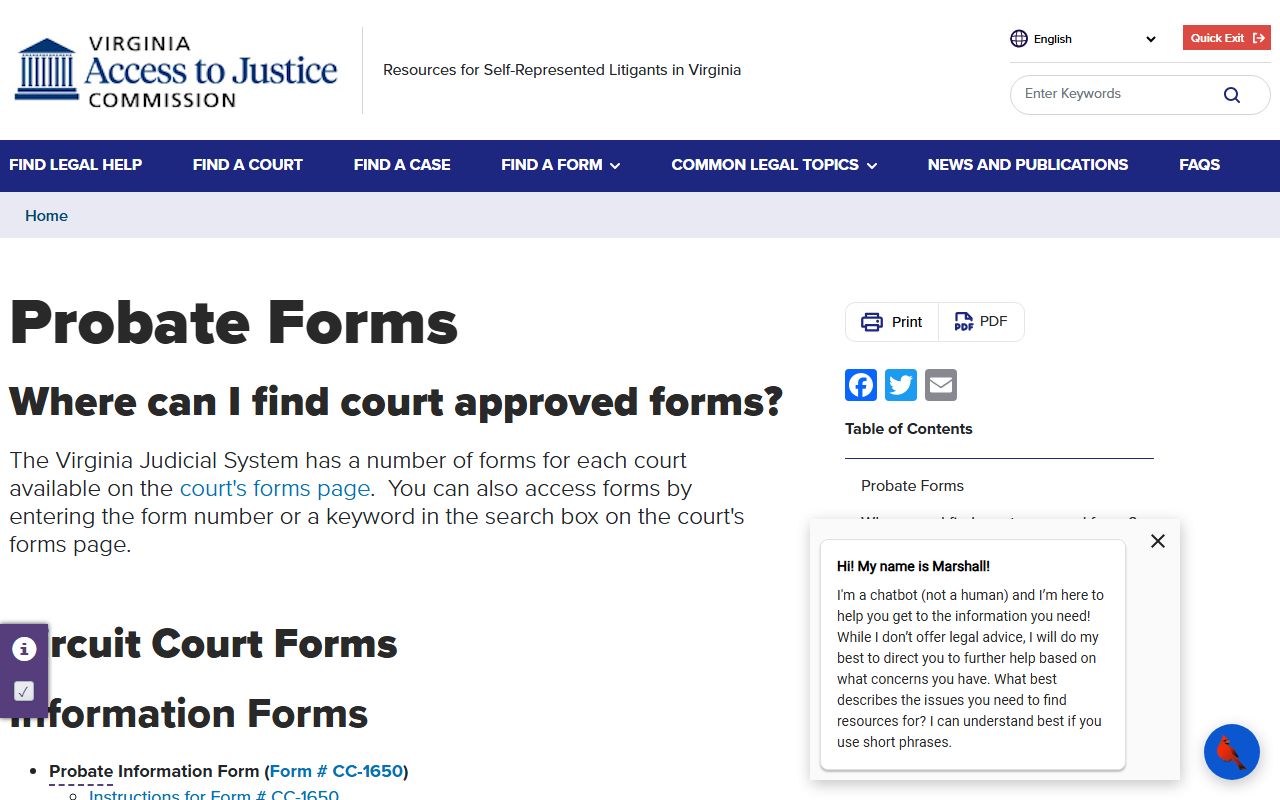
The portal lists all forms used in Virginia probate cases, including those filed in Charlotte County Circuit Court.
Estate Tax in Charlotte
Charlotte County estates may face state or federal tax filings beyond the probate tax. The Virginia Department of Taxation handles state income returns for estates. The IRS estate tax page covers federal rules.
Most small estates do not owe federal estate tax. But the executor must still file the final income returns for the person who died. Talk to a CPA for help if the estate is complex.
Nearby Counties
These counties sit near Charlotte. Each has its own Circuit Court that handles probate court records.